
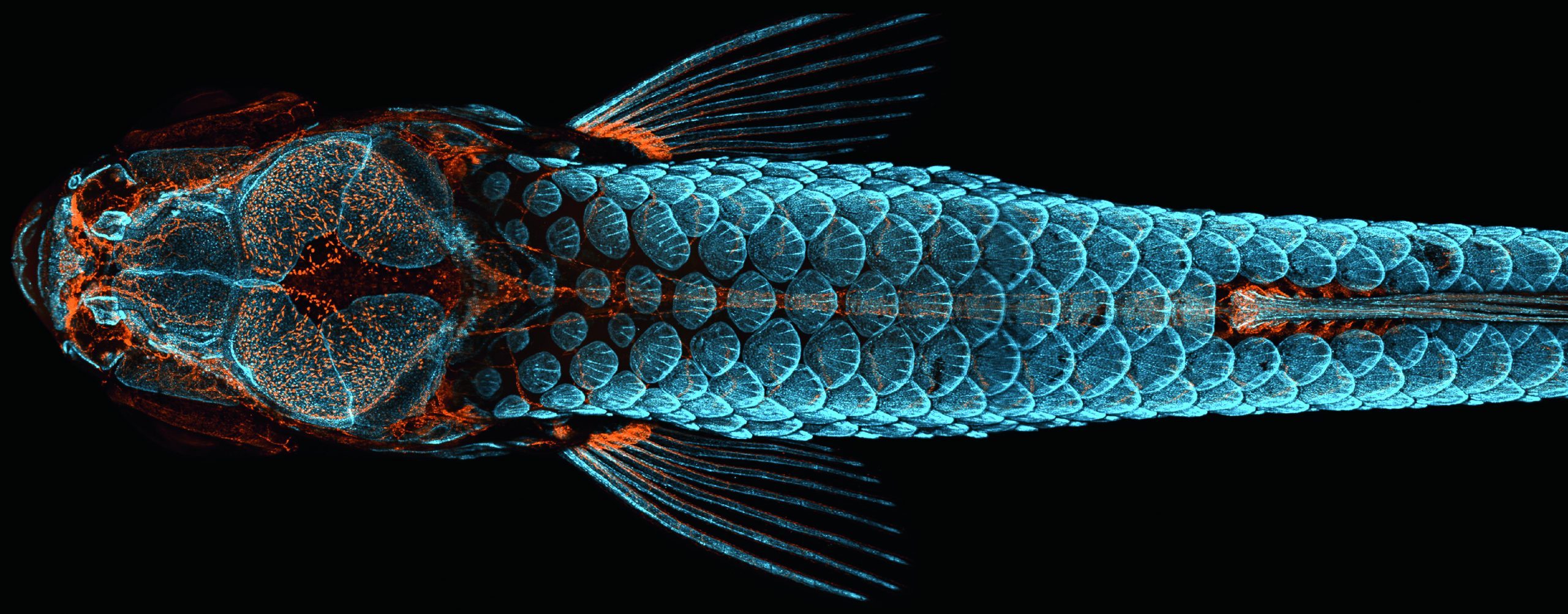
IT’S A SMALL WORLD
Daniel Castranova, assisted by Bakary Samasa while working in the lab of Dr. Brant Weinstein at the National Institutes of Health in Maryland, took the top prize for his immaculate photo of a juvenile zebrafish. The image was taken using confocal microscopy and image-stacking.
The image is particularly significant because it was taken as part of an imaging effort that helped Castranova’s team make a groundbreaking discovery – zebrafish have lymphatic vessels inside their skull that were previously thought to occur only in mammals.
Their occurrence in fish, a much easier subject to raise, experiment with, and photograph, could expedite and revolutionise research related to treatments for diseases that occur in the human brain, including cancer and Alzheimer’s.
Castranova stitched together more than 350 individual images to create this single visual. The image was acquired using a spinning disk confocal, merging together maximum intensity projections of three separate image Z stacks to generate the final reconstructed image.
“The image is beautiful, but also shows how powerful the zebrafish can be as a model for the development of lymphatic vessels,” says Castranova. “Until now, we thought this type of lymphatic system associated with the nervous system only occurred in mammals.”
Adds Eric Flem, communications manager, Nikon Instruments: “For 46 years the Nikon Small World competition’s goal has been to share microscopic imagery that visually blends art and science for the general public. As imaging techniques and technologies become more advanced, we are proud to showcase imagery that this blend of research, creativity, imaging technology and expertise can bring to scientific discovery. This year’s first place winner is a stunning example.”
Nikon Small World recognized 88 photos out of thousands of entries from scientists and artists across the globe.
For more information visit www.nikonsmallworld.com
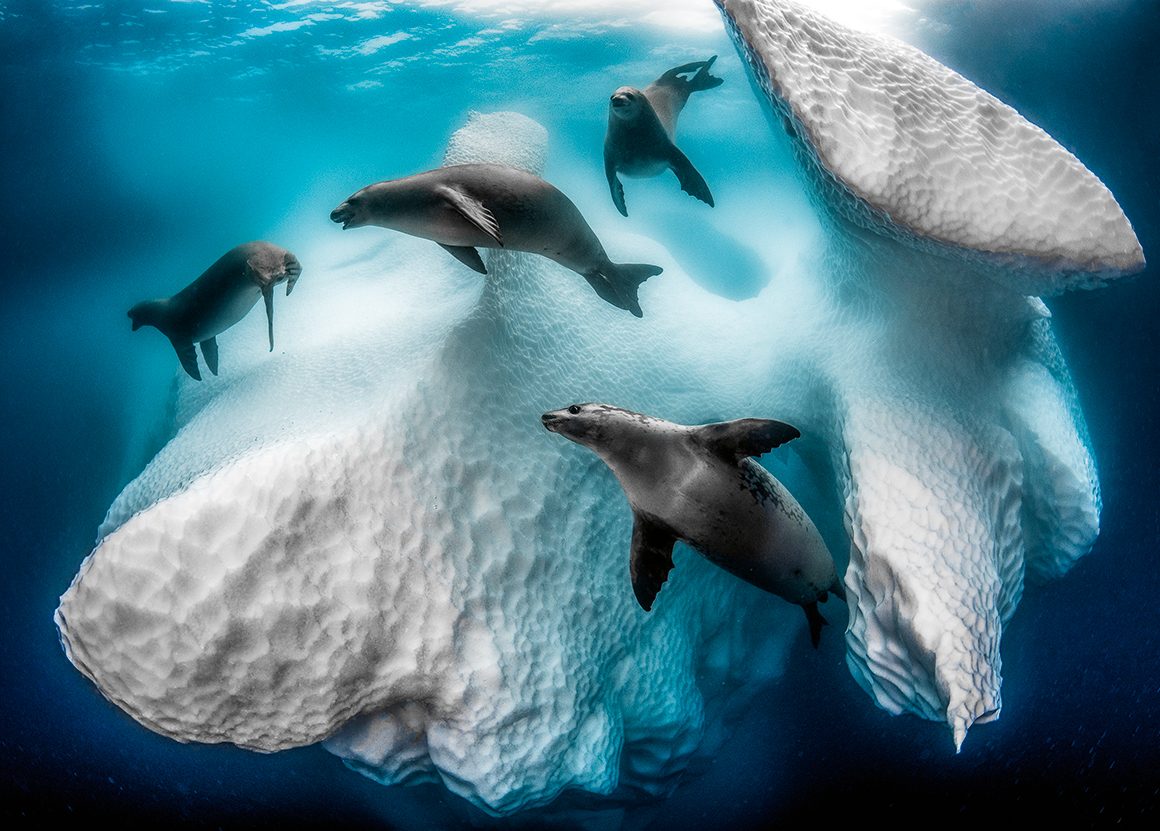
JUS’ CHILLIN’
THIS SHOT OF CRAB-EATER SEALS SWIMMING UNDERNEATH AN ICEBERG IN THE ANTARCTIC PENINSULA TOOK THE TOP AWARD AT THE 2020 UNDERWATER PHOTOGRAPHER OF THE YEAR COMPETITION IN LONDON EARLIER THIS YEAR.
The winning photographer is Frenchman Greg Lecoeur – a former National Geographic Nature Photographer of the Year winner.
“The balletic rhythm of these crab-eater seals and the ethereal landscape of the pitted iceberg creates a composition that draws you into a corner of the world that few people have witnessed,” commented one judge.
“A deserved and unanimous winner which combines photographic beauty, composition, exquisite light and delicate colours. Perfect poses from the seals make this a celebration of natural life and a most enduring image,” added another.
The photo – titled Frozen Mobile Home – also won the top award in the Best Wide-Angle category.
To shoot the picture Lecouer travelled to Antarctica on a small yacht, documenting the wildlife on icebergs as they drifted at the whim of polar currents. “Massive and mysterious habitats,” he says. “Little is known about how wildlife thrives around these mobile homes. Icebergs fertilise the oceans by carrying nutrients from land that spark blooms of marine life and also provide homes for larger animals, like these crabeater seals.”
Lecoeur lives in Nice, France but works full time as a photographer, travelling the world documenting life in the oceans.
This year’s competition attracted a record 5,500 entries from 500 photographers representing 70 countries.


