
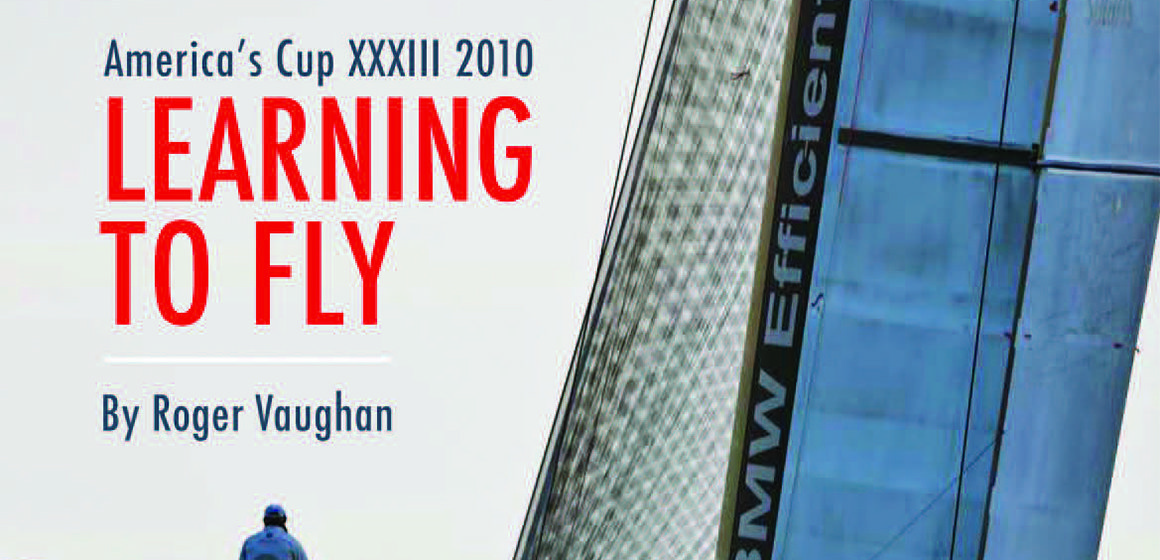
LEARNING TO FLY
PHOTOGRAPHY BY GILES MARTIN-RAGET AVAILABLE THROUGH AMAZON
WITH THE 36TH AMERICA’S Cup kicking off in March 2021 with revolutionary foiling monohulls, Learning to Fly is a fascinating insight into how the America’s Cup transitioned from monohulls to multihulls and then back to monohulls again.
Written by well-known American sailing writer and commentator Roger Vaughan, with photography by Giles Martin-Raget, this book tells the story of the 33rd America’s Cup and its lead-up from the perspective of Larry Ellison’s BMW Oracle Racing team.
Sailed off the coast of Valencia, Spain, the 2010 event was the first America’s Cup contested between multihulls, though in a travesty the Cup was defended by a multihull in San Diego in 1988.
The back story of Ellison’s involvement, first in sailing and then in the America’s Cup, and his long and fruitful involvement with New Zealand sailors and boatbuilders is enlightening: Ellison loves Kiwis and hugely admires our sailors.
Because this book is about the America’s Cup, it’s full of intrigue, rule breaking, deal making and legal challenges. The behind the scenes detail is immense.
There are many larger-than-life characters, including Aussies Glen Ashby and Jim Spithill – Ellison is a fan of both – and Kiwis Russell Coutts and Brad Butterworth.
The development of Oracle’s maxi trimaran for the 33rd edition was groundbreaking, aided and abetted by Kiwis, including ex-TNZ, ex-Alinghi super-designer Mike Drummond and US-based Kiwi boat builder Tim Smyth.
As the event got closer there were more legal updates, venue changes, sail, mast and rigging redesigns, the addition of a BMW engine to trim Oracle’s sails, and so much more. This book covers it all.
Rig loads on such a huge multi-hull were immense and failures frequent. Eventually, an expensive wingsail was agreed upon, constructed by Core Builders, then fitted and tested. The match was only months away.
In February 2010 BMW Oracle Racing’s 115-foot trimaran USA 17 faced off against Alinghi’s smaller catamaran in Valencia. Each race is covered in detail in an historic but ultimately one-sided struggle.
The era of super-fast America’s Cup racing had begun.
– John Eichelsheim
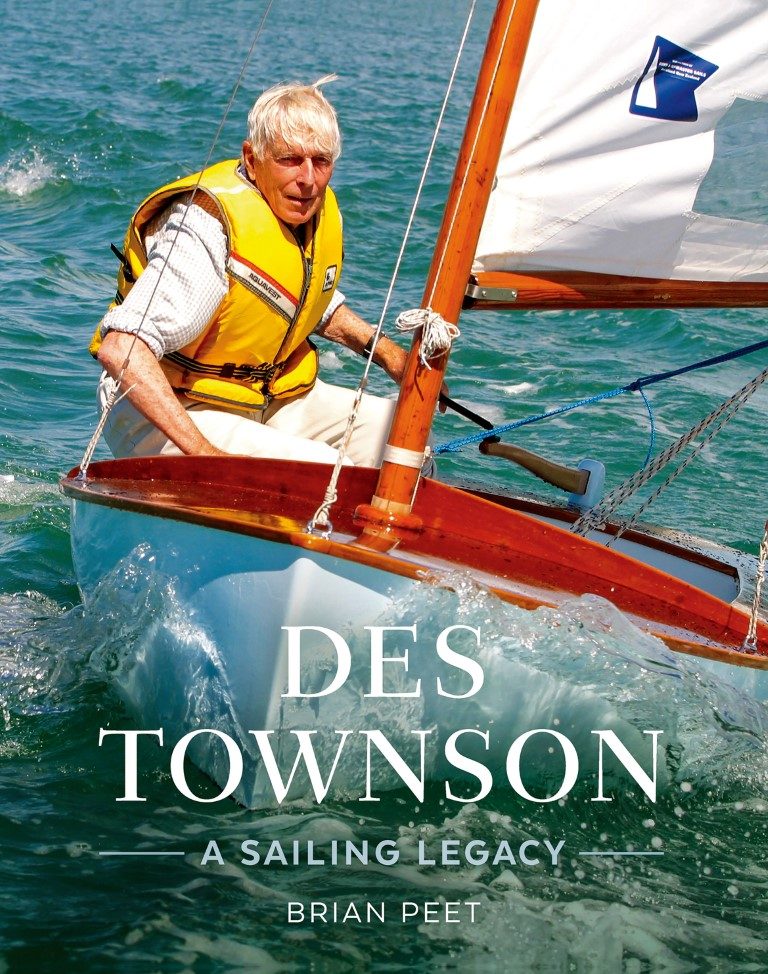
THE DEFINITIVE TOWNSON
Even if you think you know everything there is to know about Des Townson – one of the country’s best-loved designers – it’s a safe bet that reading this book will reveal a lot more about his enigmatic work and life.
Peet’s biography – meticulously researched over more than a decade – is detailed and thorough yet hugely readable. He writes with an easy, almost colloquial style – with plenty of anecdotes – a clever tactic that helps to draw you into the mind of the complex and somewhat reclusive Townson.
And it’s an intriguing portrait he paints: getting your head around the sheer volume and variety of Townson’s work is one thing (it’s a lot more diverse than I believed). That it flowed from the pen of someone who was innately shy and withdrawn, who shunned the fame and publicity his boats/designs attracted, is a great irony.
In fact, it’s that ‘human’ side of Townson that I found most fascinating in Peet’s book – the slightly fractious relationship with his father (which probably spurred his stubbornness/ determination); his remarkable powers of observation (from even a young age his ability to absorb ‘boat theory’ simply by watching others, apply it and improve on it was extraordinary); his inventiveness; his mental strength and abilities as a competitive sailor.
Enthusiasts of the Townson ‘classics’ are particularly well-served in the pages: the genesis of the Zephyr, Starling, Mistral, Dart and Pied Piper – each is explored in colourful detail. As is his venture into bigger keelers – and the race boats with their complicated rules.
The legacy is extraordinary – particularly in terms of its impact on the evolution of New Zealand sailing. So much of this country’s sailing tradition can be traced to the Townson boats still being used by youngsters learning to sail and race.
I found myself reading large swathes of this book in a single sitting – but I’d suggest much of its appeal lies in its suitability for ‘grazers’ – readers who like to dip in and out of a book over weeks or even months. It runs to nearly 350 pages and is filled with scores of rare monochrome and colour images – sourcing them must have been an epic in itself.
Plenty of material already exists about Townson. For me this is the ‘Definitive Townson’. A finely-produced publication that’s guaranteed to generate plenty of discussion if left on your coffee table. It won’t fit into a Christmas stocking, but it will look good under the tree. Ed
The book is available in most bookstores but can also be ordered from: www.destownson.co.nz
Des Townson – A Sailing Legacy By Brian Peet
Mary Egan Publishing RRP $80.00


